sales@hxdcircuits.com
+86 180 1876 7219

Why Choose HXD for Your 10-Layer PCB?

Manufacturing a 10-layer PCB is a highly complex process, far more challenging than making 2-layer or 4-layer boards.HXD has many years of experience and a mature manufacturing system in the 10-layer PCB field.

Lamination Equipment

HXD is equipped with advanced vacuum lamination systems to ensure tight bonding of multilayer structures under high temperature and high pressure.To prevent interlayer misalignment, we use a CCD + IR hybrid alignment system. keeping layer-to-layer tolerance at ≤25μm or even tighter.

High-Precision Drilling Technology

Manufacturing 10-layer PCBs often requires drilling with high aspect ratios (up to 16:1).10-layer PCBs often require drilling with high aspect ratios (up to 16:1). HXD uses both Laser Drilling for microvias and CNC Mechanical Drilling for standard holes.Our capabilities include:

  • Small Hole Diameters: Precision drilling for holes smaller than 0.15mm.
  • Microvia Technology: Laser-drilled holes for high-density interconnects.

Laser Direct Imaging(LDI)

For high-precision circuits, HXD utilizes LDI technology. This ensures maximum accuracy for fine-line patterns, such as 2.5/2.5 mil trace and space.

HDI & Microvia Technology

We are experts in Blind Vias, Buried Vias, and Laser Microvias. These technologies are essential for 10-layer High-Density Interconnect (HDI) designs.By utilizing these advanced techniques, we help you achieve higher integration and smaller form factors within limited board space.

Specialty Materials & Hybrid Lamination
HXD has the expertise to process a wide range of high-performance substrates, including high-performance FR-4, Rogers, and Isola.
We also support hybrid lamination of high-frequency materials with standard materials, helping you balance performance and cost while meeting application needs.


PCB Certifications

10-Layer PCB Stackup Overview

A 10-layer PCB is not just a simple increase in layers. It is a multilayer printed circuit board made by alternating ten conductive layers with insulating materials, with a highly complex structure and design.

    • Standard Structure:A typical 10-layer PCB has 6 signal layers and 4 plane layers (power and ground). Signal layers (Signal) and plane layers (GND/PWR) are often arranged alternately. For example: Layer 1/3/5/7/8/10 as signal layers, Layer 2/9 as ground planes, and Layer 4/7 as power planes. This layout ensures high-speed signals stay close to reference planes, minimizing loop inductance.
    • Lamination Composition:The board is made of copper foil, substrate (e.g., FR4), prepreg (for insulation and bonding), and core, all cured together under high temperature and pressure.
    • Copper Thickness:Standard board thickness ranges from 1.3mm to 3.0mm, with copper thickness typically 0.5oz to 1oz. For high-current applications, inner layer copper can be customized to be thicker.

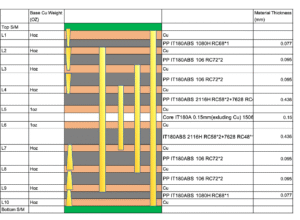
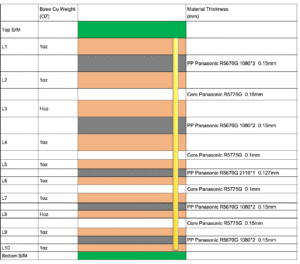
The stackup of a PCB is a key factor that determines its performance and functionality. Below are some HXD 10-layer stackup examples for reference.

10-Layer Rigid PCB Stackup Case1

10-layer-hdi-pcb-stackup

Finished Board Thickness: 1.9+/-10%mm
Application: Mobile Devices
Layer: 10L
Material: IT180A
Surface Finish: ENIG
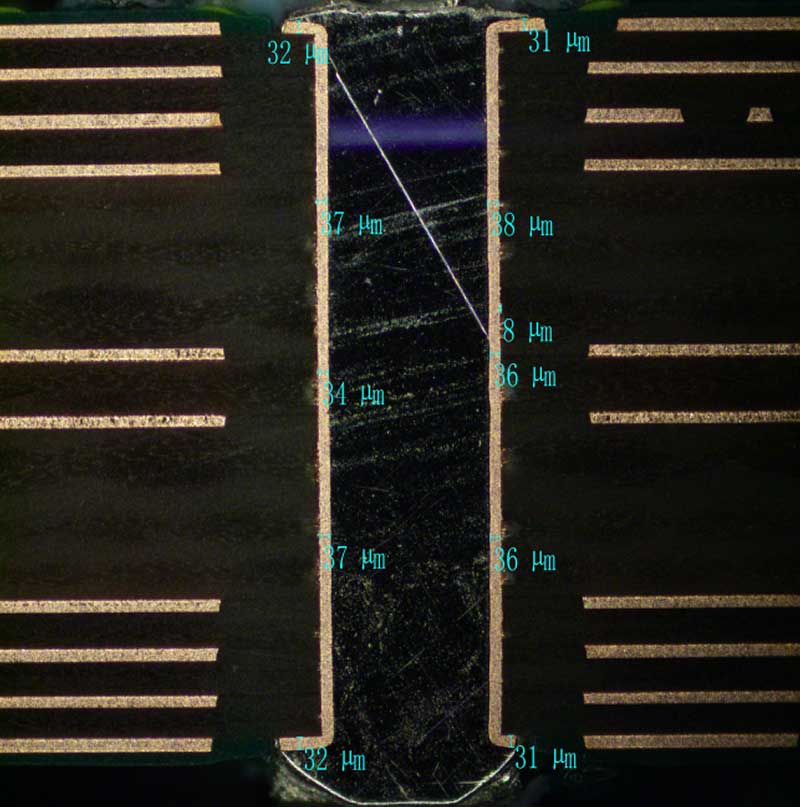
Micro-section for Hole and surface copper thickness: View Detail
Item Impedance Tolerance Layer Reference Width/spacing (mm)
1 single ended impedance lines 50ohm ±10% L1 L2 0.12
2 differential impedance pairs 100ohm ±10% L1 L2 0.1/0.25
3 single ended impedance lines 50ohm ±10% L3 L2/L4 0.125
4 differential impedance pairs 100ohm ±10% L3 L2/L4 0.075/0.175
5 single ended impedance lines 50ohm ±10% L5 L4/L6 0.165
6 differential impedance pairs 100ohm ±10% L5 L4/L6 0.112/0.175
7 single ended impedance lines 50ohm ±10% L8 L9/L7 0.082
8 differential impedance pairs 100ohm ±10% L8 L9/L7 0.075/0.175
9 single ended impedance lines 50ohm ±10% L10 L9 0.12
10 differential impedance pairs 100ohm ±10% L10 L9 0.104/0.246

10-Layer Rigid PCB Stackup Case2

10-layer-pcb-stackup

Finished Board Thickness: 1.6+/-10%mm
Application: Broadcasting
Layer: 10L
Material: Panasonic M6
Surface Finish: ENIG
Min.Line W/S: 0.2/0.2mm
Special Feature: Impedance Control
Micro-section Picture: View Details
Item Impedance Tolerance Layer Reference Width/spacing (mm)
1 single ended impedance lines
50ohm
±10% L1 L2 0.284
2 differential impedance pairs
100ohm
±10% L1 L2 0.16/0.14
3 single ended impedance lines
50ohm
±10% L1 L3 0.3
4 single ended impedance lines
50ohm
±10% L3 L2/L4 0.16
5 differential impedance pairs
100ohm
±10% L3 L2/L4 0.15/0.173
6 single ended impedance lines
50ohm
±10% L8 L9/L7 0.16
7 differential impedance pairs
100ohm
±10% L8 L9/L7 0.15/0.173
8 single ended impedance lines
50ohm
±10% L10 L9 0.28
9 single ended impedance lines
50ohm
±10% L10 L8 0.3
10 differential impedance pairs
100ohm
±10% L10 L9 0.16/0.14


Ready to start your 8-layer PCB project

Upload your Gerber files to get an instant quote.

Start Custom Quote

Comprehensive Quality Inspection System

AOI


Once a 10-layer PCB is laminated, internal defects cannot be corrected. At HXD, we implement strict monitoring throughout the manufacturing process:

  • 100% AOI (Automated Optical Inspection): We scan all inner layers before lamination to identify any open or short circuits.
  • X-Ray Inspection:  We use X-ray technology to check drill alignment and internal layer integrity after lamination.
  • Electrical Testing: Uses TDR impedance testing to verify signal integrity and VNA testing to measure high-frequency loss up to 40GHz. 
  • Reliability Testing: Includes thermal stress tests (e.g., 6 cycles of 260°C reflow), ionic contamination tests, and microsection analysis to verify hole-wall quality and interlayer bonding strength。

REQUEST A QUOTE

Supported file formats: PDF, DOC, DOCX, TXT, JPG, PNG (Max 2MB)