sales@hxdcircuits.com
+86 180 1876 7219

4-Layer PCB Manufacturing

  • No MOQ
  • PCB Type: Flex PCB, Rigid PCB, Rigid-Flex PCB
  • Material: Polyimide,FR4, Metal core, Ceramic + FR4 Hybrid, High Speed, High frequency, PTFE
  • Blind & Buried Vias by Mechanical and Laser Drill
  • 100% E-test, AOI Inspection & Visual Inspection
  • IPC Class3 compliance, UL and ISO Certified

Why Choose HXD for Your 4-Layer PCBs?

  •  Stackup : We support standard and custom 4-layer stack-up(Ground-Signal-Signal-Ground). 
  • Full Range of Thickness: From 0.8mm (for slim mobile devices) to 2.4mm (for high-power industrial equipment).
  • Diverse Substrates: We offer Standard FR-4, High-Tg, Rogers, Ceramic, and Polyimide to meet all your thermal management needs.
  • Advanced Technology: Supports blind and buried vias, controlled impedance, via-in-pad, and back-drill techniques.
  • Surface Finishes :We offer a wide range of surface finishes, including ENIG, HASL Lead-Free, OSP, Immersion Silver, Immersion Tin, and Hard Gold.

PCB Certifications

Key Benefits of 4-Layer PCB

Reduced EMI

Dedicated internal power and ground planes act as a shield to lower noise and reduce radiation

Signal Integrity

The top and bottom layers are used for both high-speed and low-speed signal routing. With proper trace layout and via placement, you can reduce crosstalk and reflection.

Impedance Control

By selecting the right dielectric materials (such as FR-4 or Rogers) and controlling trace width and spacing, we can achieve precise impedance designs (such as 50Ω single-ended or 100Ω differential)

A Cost-Effective Choice for Complex Circuits

A 4-layer PCB is much more powerful than a 2-layer board, but its manufacturing cost is significantly lower than 6 or 8-layer boards. This makes it the best choice for medium-complexity circuits.

HXD 4 Layer PCBs

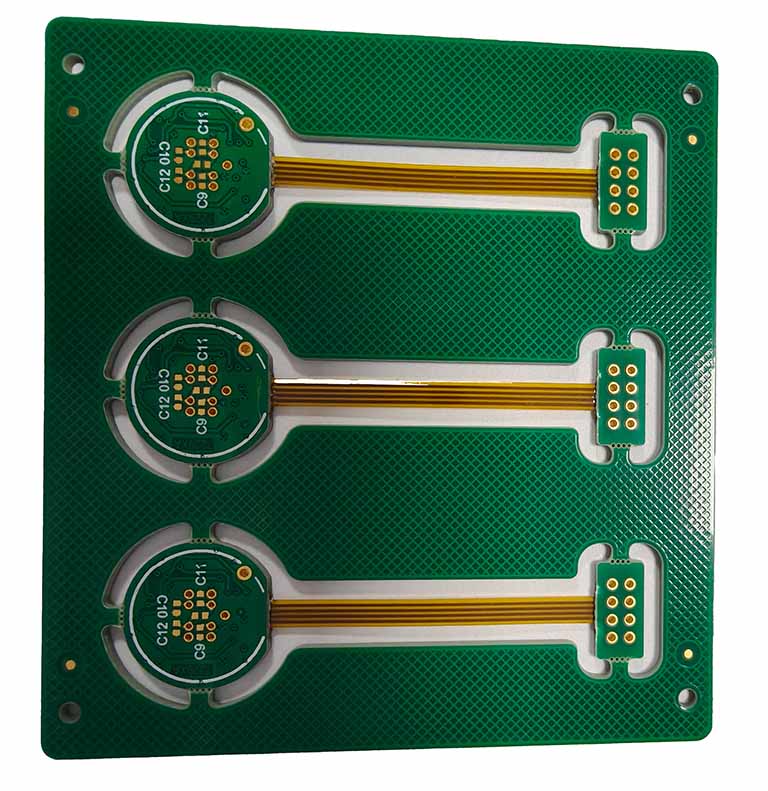
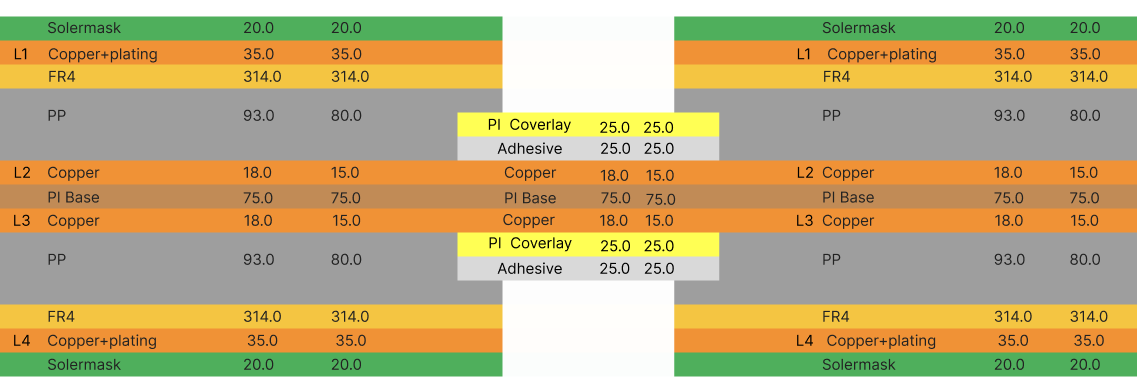
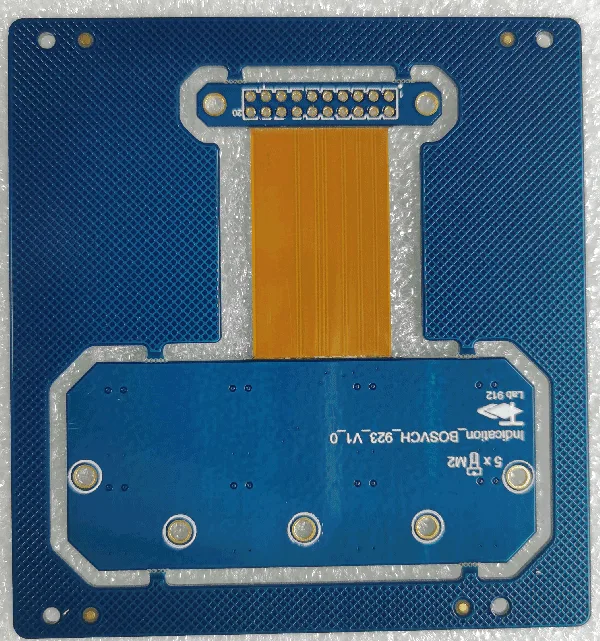
4Layer Rigid-flex PCB

4Layer Rigid-flex PCB

Stable 4-Layer Rigid-Flex Design (FR4 + PI) Combines flexibility and rigidity to support compact layouts and dynamic bending in industrial control applications.

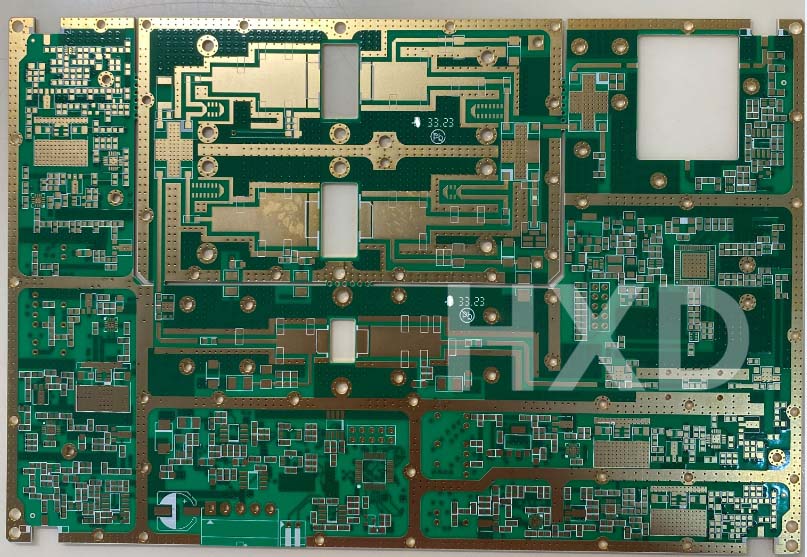
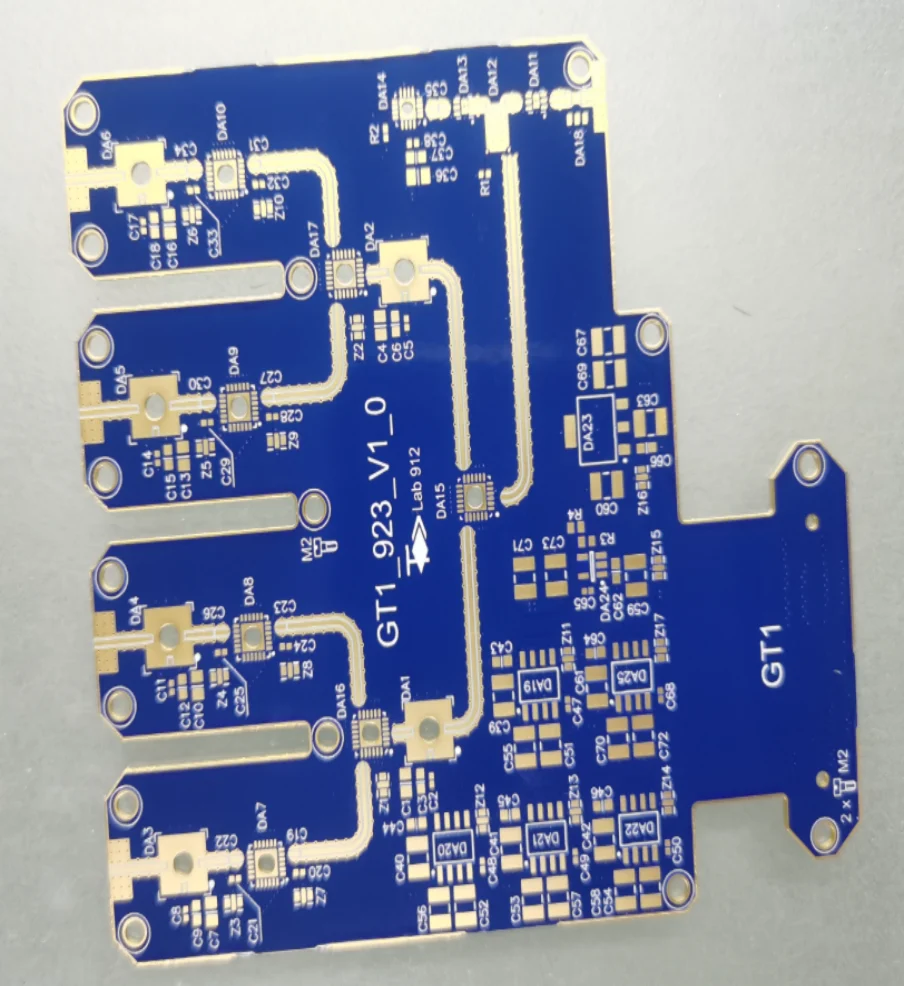
4Layer Rogers4350+FR4 with Hybrid Laminating PCB

4Layer Rogers4350+FR4 with Hybrid Laminating PCB

Rogers 4350 for RF layers + FR4 for structural layers, delivering high-frequency performance with lower material cost

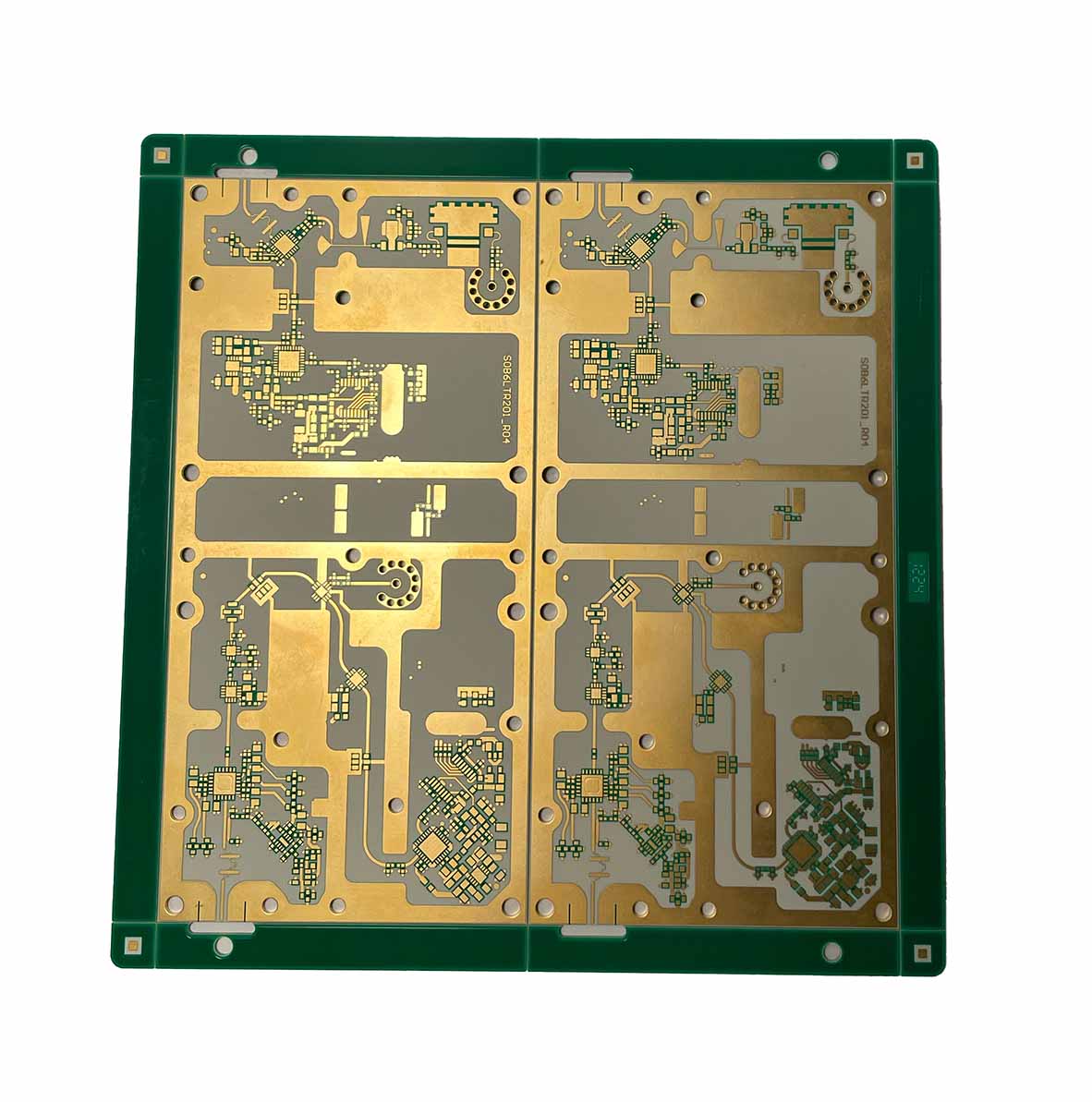
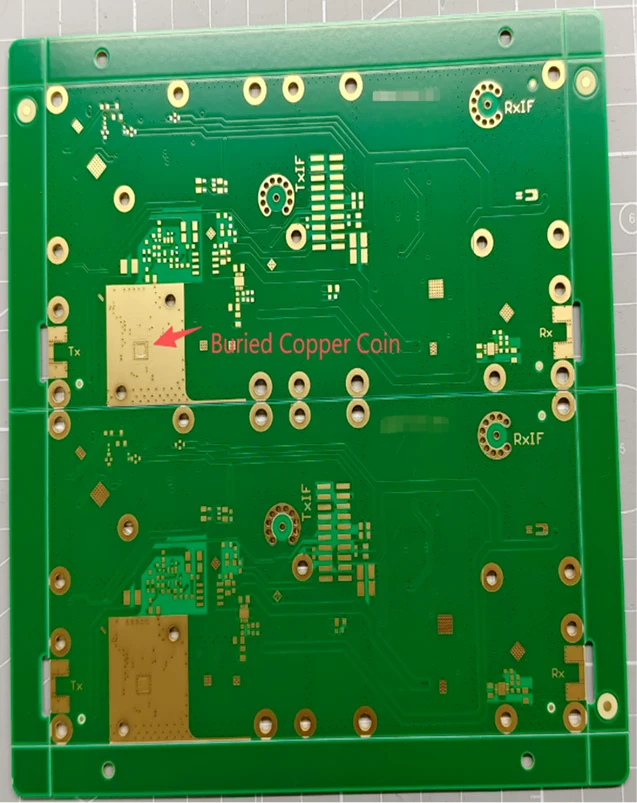
4Layer with Rogers+FR4 Hybrid Board+Copper Coin Buried

4Layer with Rogers+FR4 Hybrid Board+Copper Coin Buried

Hybrid Material: FR4 Tg170 + Rogers 4350,4-Layer Rigid Structure for Broadcasting Applications,High-Precision PCB Capability

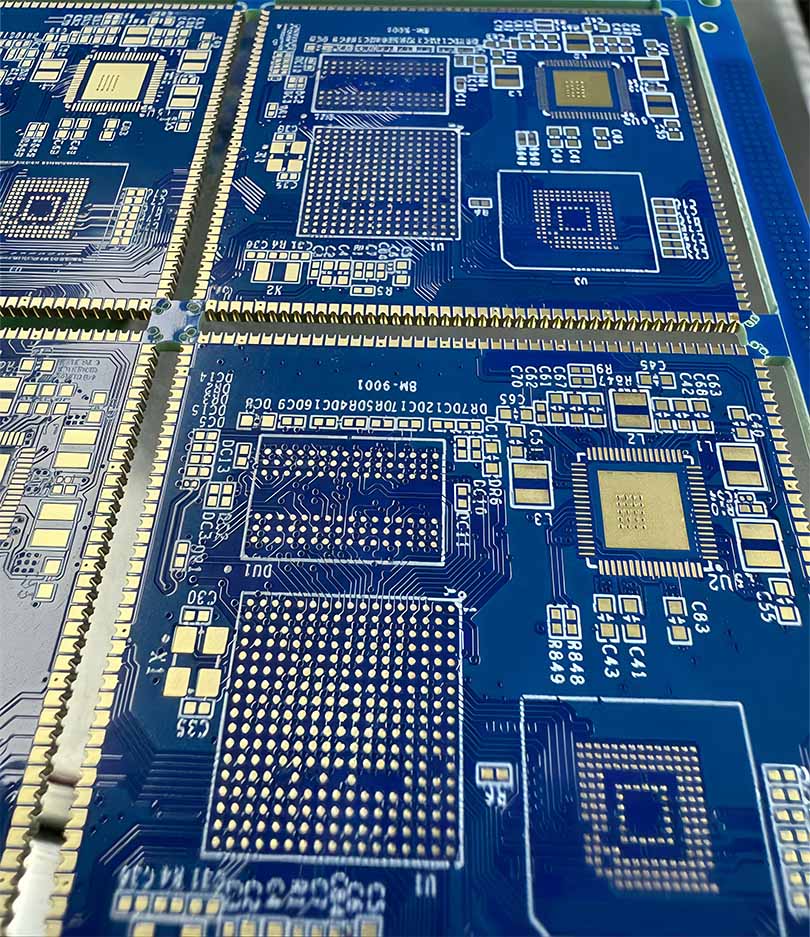
4layer with Half hole

4layer with Half hole

Edge-plated half holes enable module plug-in, board-to-board connection, and compact mechanical integration.

Ready to start your 4-layer PCB project?

Upload your Gerber files to get an instant quote.

Start Custom Quote

what is 4-layer PCB?

A 4-layer PCB is made of four conductive copper layers separated by insulating dielectric layers. This structure is widely used in many electronic products.

The four copper layers are :

  • Top and Bottom Layers: Used for component placement and signal routing.
  • Two Internal Layers: Typically used as the Power Plane (VCC) and Ground Plane (GND).

Compared to a 2-layer PCB, a 4-layer design offers significant advantages in signal integrity, EMI control, and routing density.

4-layer PCB Stackup

There is no single 4-layer stack-up that fits every product. Designers should choose the most suitable stackup based on specific needs, such as electrical performance, EMI control, power distribution, and routing requirements, the following stack-up are commonly used.

Signal – GND – PWR – Signal

This is the most widely used stackup structure. It offers a perfect balance between circuit complexity, manufacturing cost, and electrical performance. It is ideal for the following applications:

  • IoT Devices & Sensors: Smart home and connected products.
  • Industrial Control & Automotive Electronics: Reliable performance for tough environments.
  • Consumer Electronics: Smartphones, tablets, and home appliances.

GND – Signal – Signal – GND

This structure effectively blocks external interference from entering the circuit and prevents internal signals from radiating outwards. It is commonly used for high-speed digital designs that are extremely sensitive to noise, though it also brings some design challenges.

Signal – GND – GND – PWR

This is a power-focused structure. If your PCB is mainly designed to drive motors or handle high-power conversion with simple control logic, this structure is perfect. It provides a more stable power supply and a cleaner grounding environment than standard stack-up.

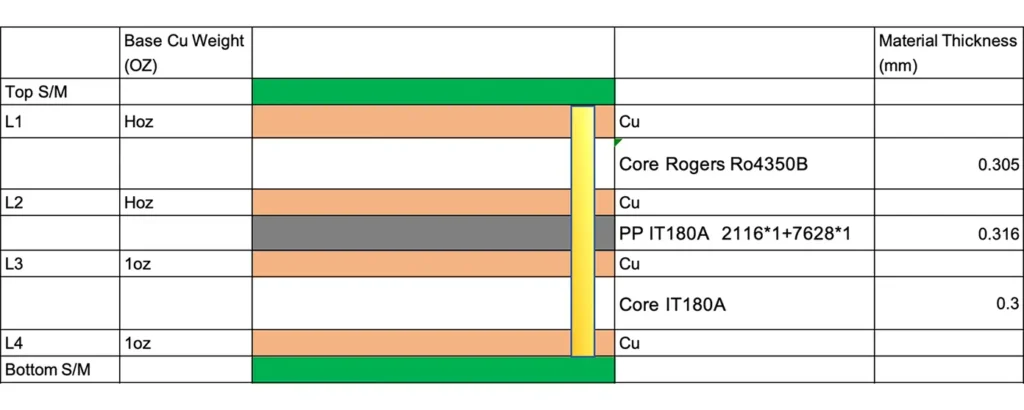
The following are HXD’s commonly used 4-layer PCB stackups,You can also explore our Flex PCB Stackup  and   rigid-flex PCB stackup options.

HXD 4-layer High Frequency PCB Stackup

Application Communication
Type High Frequency Hybrid Rigid PCB
Material Ro4350B(Tg>280)+IT180A
Surface Finish ENIG
Special Feature: Full edge gold plating

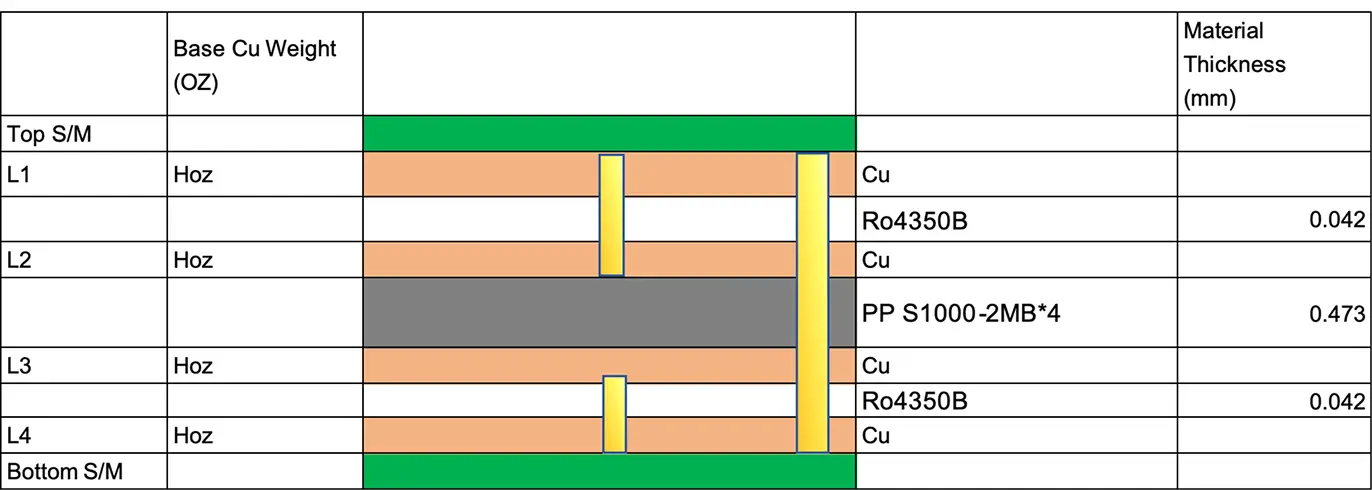
4-layer High Frequency Hybrid PCB+HDI Stackup

Application Communication
Type High Frequency Hybrid Rigid PCB
Material Ro4350B(Tg>280)+IT180A
Surface Finish ENIG
Special Feature: Full edge gold plating

FAQ

What factors affect the cost of 4-layer PCB manufacturing?

The cost of 4-layer PCB manufacturing depends on several key factors:

  • Board Size: Larger boards require more materials, which leads to higher costs.

  • Surface Finish: For example, ENIG (Gold) is typically more expensive than HASL (Solder).

  • Design Complexity: Features like Blind and Buried Vias or Controlled Impedance requirements will increase manufacturing difficulty and cost.

  • Copper Thickness: Using heavy copper (such as 2oz) will add to the total price.

What is a “Standard Stackup” for a 4-Layer PCB?

The most common stackup is Signal – GND – PWR – Signal.

Placing the power and ground layers in the middle has two key benefits:

  • EMI shielding: The inner plane layers act as shields and reduce electromagnetic radiation.

  • Lower impedance: A smaller distance between the power and ground planes lowers plane impedance and improves circuit stability.

What are the standard thickness and materials for a 4-layer PCB?

The most common thickness for a 4-layer PCB is 1.6 mm.Other options are also available, such as 0.8 mm for mobile devices, and 1.2 mm or 2.0 mm for special needs.

For materials, FR-4 is the standard choice.For high-power designs or harsh environments, High-Tg materials, Rogers, or ceramic substrates can also be used.

REQUEST A QUOTE

Supported file formats: PDF, DOC, DOCX, TXT, JPG, PNG (Max 2MB)