
Medical Device PCB Types and Certifications
 steve ran
May 14, 2026
steve ran
May 14, 2026
Introduction
A medical device PCB carries signals, power, and data inside medical equipment. If a medical device PCB fails, it may affect device accuracy or patient safety. This is why medical device PCB design needs careful control over materials, manufacturing, and testing.
This guide explains common medical device PCB types and key certification requirements. It also helps you understand how to choose a PCB manufacturer for medical devices.
What Makes a Medical Device PCB Different
Low Tolerance for Failure
Medical device PCBs often need IPC Class 3 quality. This means tighter control over hole wall copper thickness, plating quality, and inspection.
These requirements help the board stay reliable in critical medical applications where failure is not acceptable.
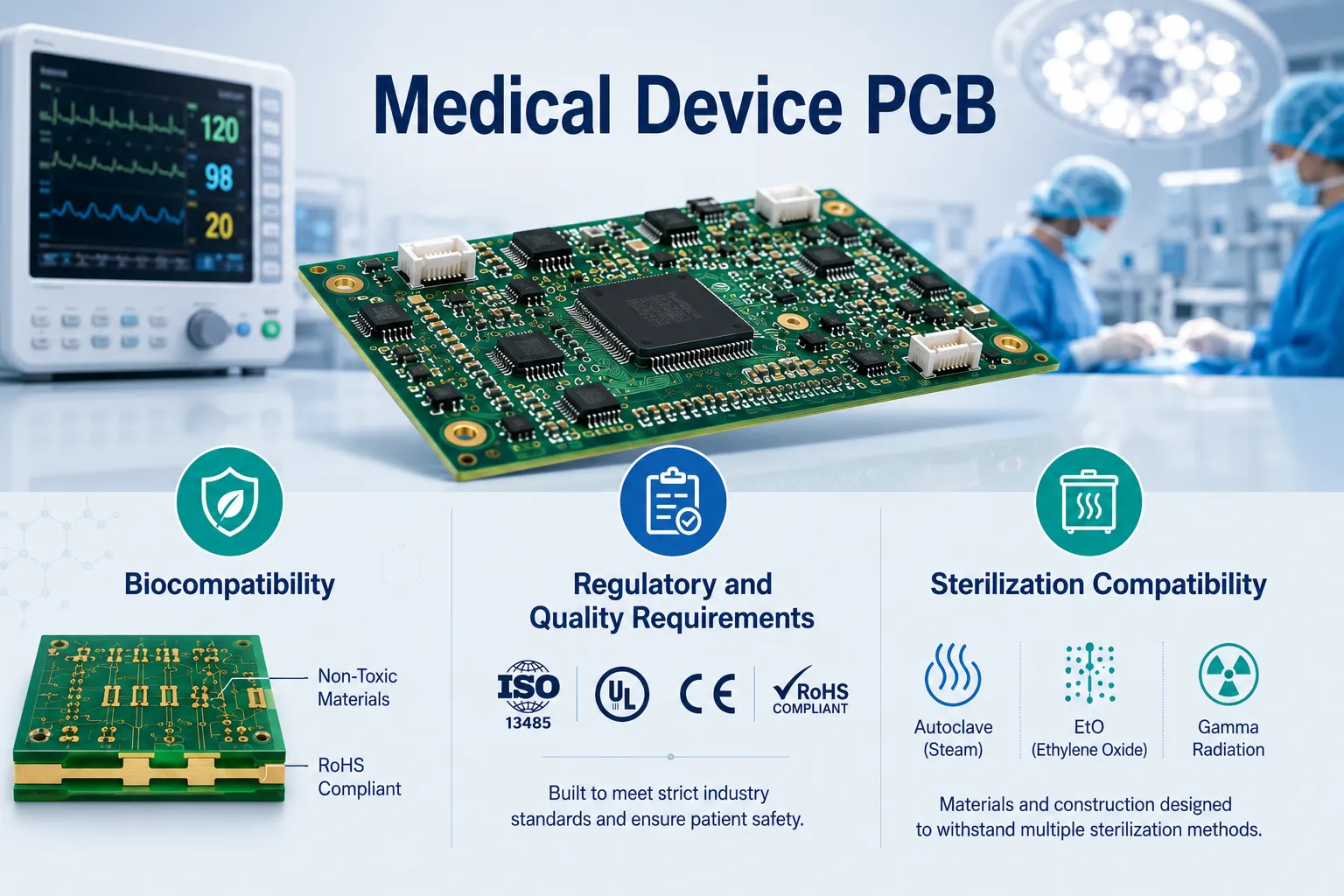
Biocompatibility
PCBs used in patient-contact devices need careful material selection. These devices may include surgical instruments, wearable monitors, and implantable electronics. The PCB materials, coatings, and surface finishes must not create safety risks for the patient.
Regulatory and Quality Requirements
Medical products often need stricter quality and compliance control than consumer electronics. Common standards and requirements may include:
- ISO 13485 for medical device quality management
- IPC Class 2 or IPC Class 3 for PCB acceptance levels
- RoHS and REACH for material compliance
- IEC 60601-1 for medical electrical safety
Sterilization Compatibility
Many medical devices need sterilization before use. This process can place stress on the PCB materials.
Ethylene oxide, or EO sterilization, exposes the board to chemical agents. Autoclave sterilization uses high-pressure steam and temperatures above 120°C. These methods can affect PCB materials in different ways.
High-Tg laminates and polyimide substrates usually handle heat and chemical exposure better than standard FR-4. You should check sterilization needs before choosing materials.
If the PCB material breaks down during sterilization, the board may lose reliability. This problem can be hard to find with normal testing alone.
Medical Device PCB Types
Different medical devices need different PCB structures. The right choice depends on board size, component density, flexibility, reliability needs, and working environment.
Rigid PCB
Rigid PCBs are common in diagnostic imaging equipment, laboratory analyzers, and hospital monitoring systems. They provide strong mechanical support and stable electrical performance.
CT scanners, MRI signal processors, and ultrasound mainboards often use multilayer rigid PCBs. These boards may use 4 to 16 layers or more, depending on the circuit complexity.
Rigid PCBs support dense component placement and controlled impedance routing. High-Tg FR-4 works for many rigid medical PCB applications. RF sections may need Rogers or PTFE laminates on selected layers.
Flex PCB
Flex PCBs can bend and fold around tight or irregular spaces. This makes them useful for endoscopes, wearable biosensors, and handheld medical monitors.
Polyimide is a common flex PCB material. It handles bending better than rigid materials and offers good heat resistance.
You should define the minimum bend radius carefully. If the flex PCB bends beyond its limit, the copper traces may crack over time. This can cause unstable signals or early failure.
Rigid-Flex PCB
Rigid-flex PCBs combine rigid areas and flexible areas in one board. The rigid sections support component mounting. The flex sections help route circuits through tight three-dimensional spaces.
Implantable devices, hearing aids, and surgical handpieces often use rigid-flex PCB construction. This design can fit complex circuits into small housings.
Rigid-flex PCBs also reduce the need for connectors and cables. This can improve reliability because connectors are common failure points. Rigid-flex boards cost more than standard rigid or flex boards. But they can be worth the cost in high-reliability medical devices.
HDI PCB
HDI PCB helps place more circuits in a smaller area. It uses laser-drilled microvias, via-in-pad technology, and fine-line traces.
Patient monitoring devices, glucose sensors, and portable diagnostic tools often use HDI PCB to reduce board size without losing function.
HDI production requires advanced equipment and stable process control. Manufacturers must carefully manage laser drilling, direct laser imaging, plating, and lamination to keep the board reliable.
Need the right PCB type for your medical device? HXD can review your design requirements.
Compliance and Standards for Medical PCB
Before production starts, you must understand which standards apply to the final product.
The required standards depend on the device type, risk level, target market, and application.
ISO 13485
ISO 13485 is important for medical device PCB manufacturing. It shows that the manufacturer has controlled processes for production, documentation, supplier management, and quality inspection.
Medical device customers often care more about whether their supplier has an ISO 13485-certified quality management system.
IPC Class 2 and IPC Class 3
IPC-A-600 and IPC-6012 define quality and acceptance requirements for rigid PCBs.
IPC Class 2 is common in general electronic products. Some medical monitoring and diagnostic devices may also use Class 2 if the product risk is low.
High-reliability products use IPC Class 3. These products must work continuously, and failure is not acceptable. Medical implants, life-support equipment, and surgical systems may require Class 3.
The designer should confirm the required IPC class before the project begins.
IEC 60601-1
IEC 60601-1 applies to medical electrical equipment. It covers safety and essential performance.
This standard includes requirements for electrical safety, insulation, leakage current, protective earth, and EMC performance.
PCB layout can affect IEC 60601-1 compliance. Designers should plan creepage, clearance, grounding, isolation areas, and EMI control early in the PCB layout.
Good planning can reduce design changes during certification testing.
RoHS and REACH
RoHS limits the use of certain hazardous substances in electronic products. These include lead, mercury, cadmium, hexavalent chromium, and some flame retardants.
REACH controls the use of chemicals in products sold in certain markets.
Most medical device PCBs use lead-free processes to meet RoHS requirements. Some special medical products may need extra review before material and solder choices are made.
Designers should confirm material requirements early, especially for products that contact patients or enter regulated markets.
FDA 21 CFR Part 820 for the U.S. Market
Medical devices sold in the United States may need to meet FDA quality system requirements.
For PCB procurement, this means the manufacturer should support clear records and quality documents. These may include material records, incoming inspection records, production records, test reports, and change records.
These records help the medical device manufacturer manage quality risk and support the final device approval process.
What Medical Device PCB Capabilities Does HXD Offer?
HXD holds ISO 13485 certification. We support custom PCB design for medical devices.
Our medical PCB capabilities include:
- Layer count: 2 to 20+ layers, including HDI boards with blind and buried vias
- Minimum line width and spacing: 3 mil / 3 mil standard, 2 mil available for HDI projects
- Controlled impedance: ±5% standard, ±3% available with TDR testing
- Materials: High-Tg FR-4, polyimide, Rogers, PTFE, and hybrid stackups
- Via types: through-hole vias, blind vias, buried vias, laser-drilled microvias, and via-in-pad
- Surface finishes: ENIG, Immersion Silver, and OSP
- Quality level: IPC Class 2 and IPC Class 3 manufacturing
- Records: material records, production records, and inspection reports
- Production support: quick-turn prototypes and volume production
Need a Reliable Medical Device PCB Manufacturer?
Conclusion
Medical device PCB design requires more care than standard PCB design. These boards must support patient safety, signal accuracy, long-term reliability, and strict quality control.
If you need a PCB manufacturer for medical devices, HXD can help. We support IPC Class 3 manufacturing and ISO 13485.
We also offer specialty materials for RF or flex medical applications. Contact us to discuss your requirements and receive a detailed quotation.
FAQ