Standard FR4 vs High-Tg FR4: A Designer’s Selection Guide
 steve ran
May 25, 2026
steve ran
May 25, 2026
Introduction
Standard FR4 works well for many PCB designs, but not every application can use standard material safely. As PCB operating temperatures rise, engineers must focus more on thermal reliability during assembly and long-term use.
This guide explains the differences between standard FR4 and High-Tg FR4. It covers Tg values, thermal performance, cost, and typical uses. It also helps you decide which material is the better choice for your PCB design.
Why PCBs Fail: CTE Mismatch and PTH Barrel Cracks
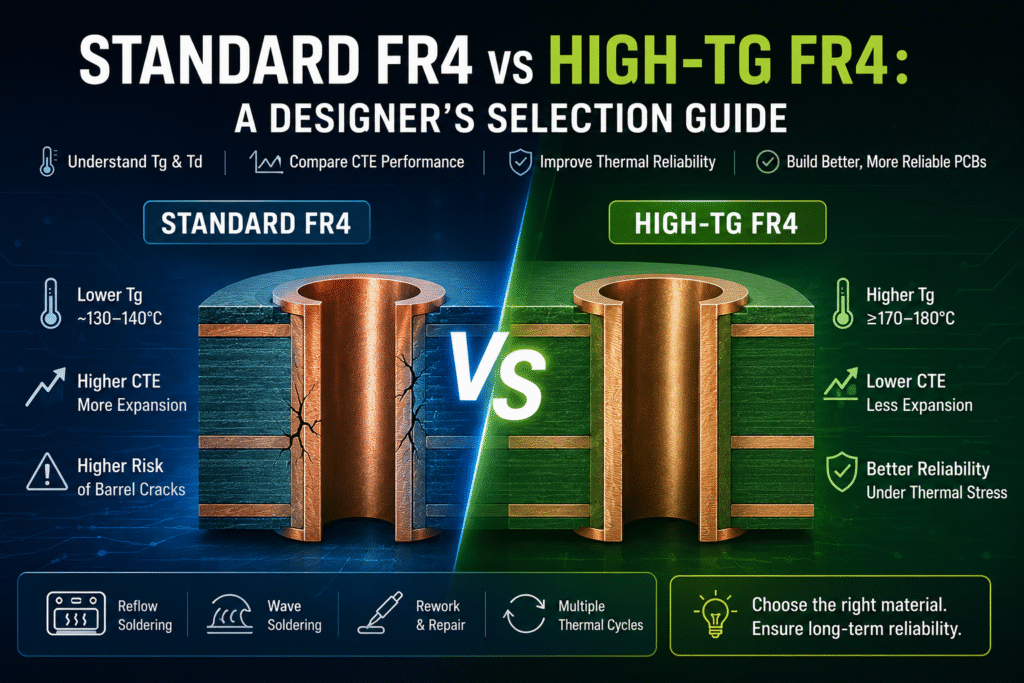
Every PCB laminate has a coefficient of thermal expansion (CTE), which describes how much the material expands as temperature rises. Below the glass transition temperature (Tg), standard FR4 materials have a Z-axis CTE of about 60–70 ppm/°C.
Once the temperature exceeds Tg, the resin structure softens and the Z-axis expansion rate increases sharply, often reaching 250–300 ppm/°C. This becomes a major reliability concern during lead-free assembly processes.
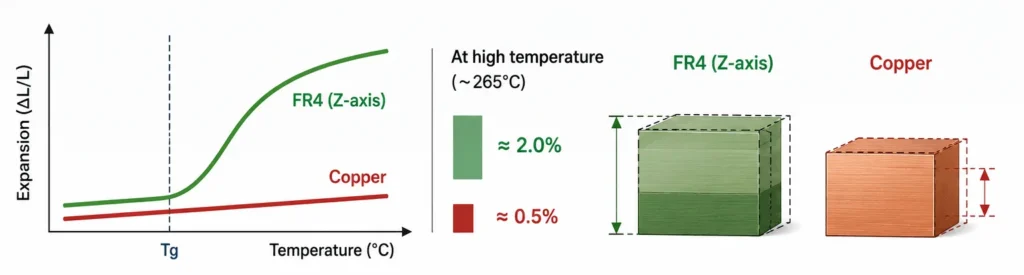
In lead-free reflow soldering, PCB peak temperatures typically reach 240–260°C. At around 265°C, the FR4 resin can expand by nearly 2% in the Z-axis direction. In comparison, copper expands by only about 0.5%.
This large difference in expansion creates tensile stress inside the plated through-hole (PTH) copper wall. Although a single reflow cycle may not immediately damage the via barrel, repeated thermal cycles gradually accumulate fatigue stress. Double-sided reflow, wave soldering, and rework processes continuously pull on the copper wall until cracks eventually form.
Complex PCB assemblies often experience four or more thermal cycles during manufacturing. Boards exposed to repeated thermal shock should therefore use High-Tg and high-Td FR4 materials to improve long-term reliability.
For this reason, PCB designers evaluate both Tg and Td when selecting laminate materials. Tg indicates when the resin begins to soften, while Td represents the temperature at which the resin starts to chemically decompose. For lead-free assembly, a Td of at least 340°C is generally recommended.
Standard FR4 vs High-Tg FR4
The table below compares the two material families across the properties that matter most during design and assembly.
| Property | Standard FR4 | High-Tg FR4 |
| Tg Range | 130–140 °C | 170–180 °C |
| Max Safe Operating Temp | ~110 °C | ~150 °C |
| Lead-Free (RoHS) Ready | Risky | Yes |
| Z-Axis CTE (above Tg) | 250–300 ppm/°C | Significantly lower |
| Layer Count Suitability | 1–4 layers (typical) | 6+ layers recommended |
| Relative Cost | Baseline | +20–40% |
| Typical Brands | Shengyi S1141, Nanya NP-140G | Isola 370HR, Shengyi S1000-2, ITEQ IT-180A |
High-Tg FR4 costs 20–30% more per board than standard grades. For a typical 100 × 100 mm four-layer board, the premium adds roughly $0.20–$0.50 per unit. That figure matters in high-volume production but rarely justifies choosing the wrong material in a reliability-critical design.
High-Tg FR4 Material Brands — What to Specify to Your Fabricator
Specifying only “High-Tg material” on a fabrication drawing invites substitution. Fabricators operating under cost pressure may select the cheapest laminate that technically meets a generic Tg requirement. Naming the exact brand and grade locks in the performance you designed for.
The most widely used High-Tg FR4 laminates:
• Shengyi S1000-2 (Tg 180°C, Td 340°C): Cost-effective high-Tg laminate with wide availability in Asia; suitable for production boards requiring dual lead-free reflow.
• Isola 370HR (Tg 180°C): Industry-standard high-Tg material widely used in North America; commonly specified for multilayer boards and IPC Class 3 assemblies.
• ITEQ IT-180A (Tg 175°C): Reliable alternative to 370HR; used in automotive and industrial applications; can replace S1000-2, S1170, and 370HR in many designs.
• Ventec VT-47 (Tg 180°C): Halogen-free laminate compliant with RoHS and UL 94 V-0; suitable for designs requiring both environmental compliance and thermal stability.
• Shengyi S1170 / S1180 — strong mid-to-high Tg options for automotive non-critical and power electronics applications.
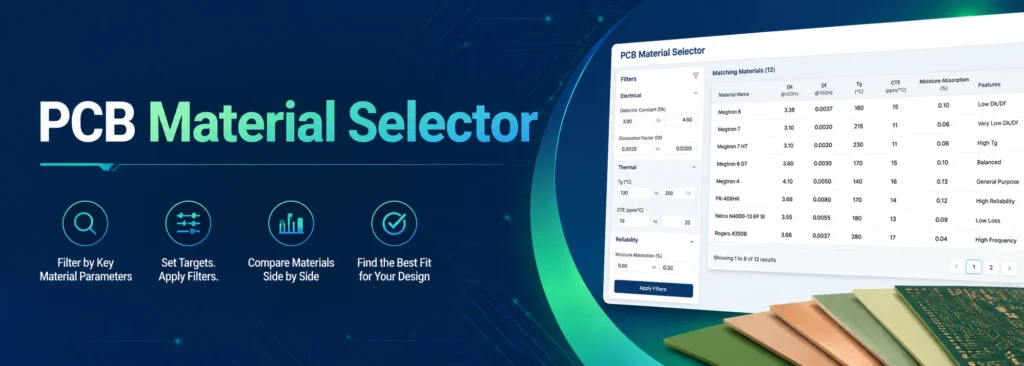
If you want to learn more about High-Tg materials, you can use our PCB Material Selector tool.
Print the exact laminate manufacturer and part number on your fabrication drill drawing. This single step blocks cheaper substitutions and improves first-pass assembly yield.
IPC Standards for FR4 Material Selection
IPC-4101 (Specification for Base Materials for Rigid and Multilayer Printed Boards) classifies FR4 laminates by slash sheet:
• IPC-4101/21 — standard FR4, Tg ≥ 110 °C
• IPC-4101/26 — High-Tg FR4, Tg ≥ 150 °C
• IPC-4101/126 — High-Tg FR4 with inorganic fillers; lower Z-axis CTE; preferred for high-reliability multilayer designs
When ordering from a fabricator, referencing these slash sheets helps avoid confusion. Instead of writing “High-Tg material,” specify “IPC-4101/126” along with your preferred laminate brand.
For layer count and thermal reliability, IPC-6012 Class 3 sets the baseline. It applies to high-reliability products like automotive and medical devices.
Hybrid Stackups
Some high-layer-count designs use a hybrid approach. They use high-Tg FR4 on outer layers and key signal layers, and use standard FR4 on inner structural layers.
This strategy lowers material costs on 8-layer or 12-layer boards. It still keeps thermal reliability where reflow heat hits hardest.
Discuss this option with your fabricator early — not every facility supports mixed-material lamination, and prepreg compatibility requires careful review.
Checklist for Your Next Design
Use the checklist below before submitting your fabrication files
| Choose High-Tg FR4 | Standard FR4 Suffices | |
| ✓ | You use lead-free (SAC305) soldering | You use leaded (SnPb) soldering |
| ✓ | Your board has 6 or more layers | Your board has 4 or fewer layers |
| ✓ | Operating temperature exceeds 100 °C | Operating temperature stays below 85 °C |
| ✓ | Your board undergoes 2+ reflow cycles or rework | Single reflow, no rework expected |
| ✓ | Application: automotive, industrial, medical | Application: consumer, hobby, low-power |
| ✓ | Dense BGA or fine-pitch components present | Standard through-hole or leaded SMD only |
Need Better Thermal Reliability for Your PCB Design?
Conclusion
Standard FR4 and High-Tg FR4 are not competing products — they solve different problems. Standard FR4 is the most cost-effective substrate for most electronics designs. It suits low-to-medium layer counts, leaded or light lead-free assembly, and stable operating environments.
High-Tg FR4 is justified when thermal stress affects reliability, such as in multi-pass lead-free reflow, high layer counts, high-temperature operation, or rework-heavy assemblies. Choosing the wrong grade at the design stage can cost far more in field failures and rework than upgrading the material.
Use the checklist before your next fabrication order. Specify the laminate by brand and IPC slash sheet to ensure your board performs as designed, even under demanding thermal conditions.
FAQ
Frequently Asked Questions
What Is Glass Transition Temperature (Tg)
When the PCB runs above its Tg for a long time, heat can crack via copper walls. This can cause intermittent open circuits.
What is the difference between Tg 150, Tg 170, and Tg 180 FR4?
Tg 170 covers most production boards using SAC305 solder across 4–12 layers.
Tg 180 targets the most demanding environments — aerospace, military, and complex multilayer boards requiring multiple rework passes.
Each grade raises the continuous operating ceiling by roughly 5–10 °C and improves resistance to Z-axis thermal expansion.
Does High-Tg FR4 improve signal integrity?
However, designers gain indirect signal integrity benefits: High-Tg materials maintain more stable Dk values as temperature rises, which reduces impedance drift in high-speed traces during thermal cycling.
For sub-5 GHz designs, this benefit is minimal. For RF and millimeter-wave designs, consider dedicated low-loss laminates such as Rogers or PTFE-based materials.
Which High-Tg FR4 brand should designers specify for automotive designs?
For cost-optimized production in Asian supply chains, Shengyi S1000-2 delivers comparable thermal performance with broad factory availability and stable supply.