
Why PCB Prices Are Increasing in 2026
 steve ran
July 9, 2026
steve ran
July 9, 2026
Think Deeper with AI:


In 2026, PCB prices are rising because the industry is facing a structural supply chain squeeze. AI server PCB demand is consuming more high-end capacity, while PP resin price, fiberglass cloth costs, copper prices, energy costs, and logistics risks are all adding pressure at the same time.
This article analyzes the real situation in the high-end PCB supply chain. Helping your team keep projects moving in an uncertain market.
AI Server PCB Demand Is Driving PCB Price Increases
Over the past few years, competition in the artificial intelligence industry has focused mainly on GPUs and computing power centers.
But in 2026, the market is facing a clear reality: no matter how powerful an AI system becomes, it still depends on PCBs to connect power supplies, memory, processors, and other critical components.
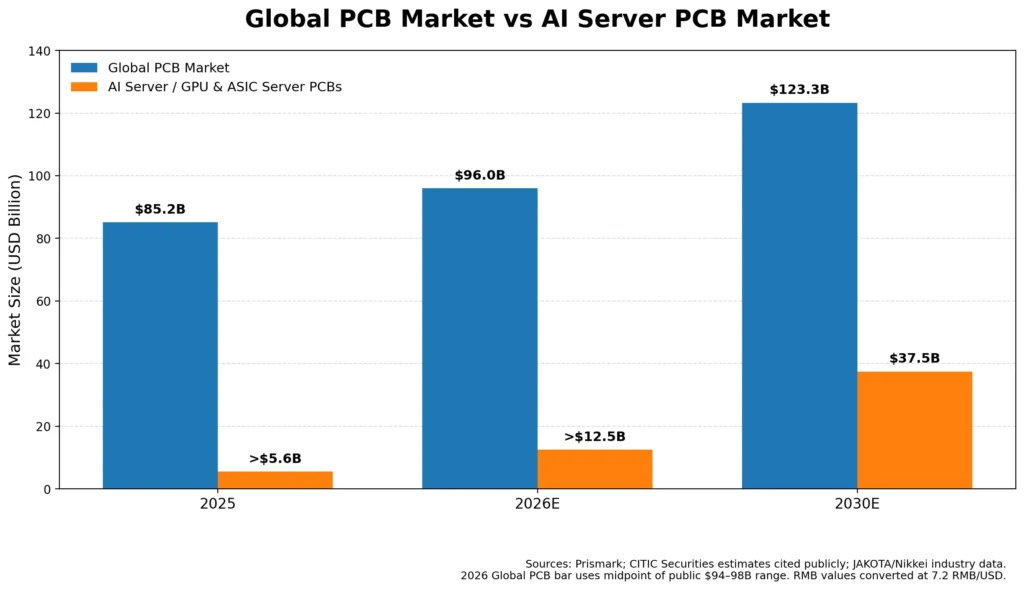
An AI server PCB must support higher computing density, faster signal transmission, and better thermal reliability. This requires more layers, and high-speed materials with lower signal loss.
As a result, high layer count PCBs, HDI PCBs, and low-loss PCBs have become essential for AI infrastructure. The rapid growth of the AI server PCB market is also making high-end PCB capacity more valuable and harder to secure.
Leading PCB factories are now busy producing AI-related orders, leaving limited available capacity for other projects. Expanding high-end PCB capacity is not a quick process. It requires long equipment delivery cycles, strict process validation, and customer qualification. Therefore, top factories are expected to remain fully loaded for some time.
From a supply chain perspective, this is not just a short-term demand spike. It is a structural shift driven by AI infrastructure. As the AI server PCB market continues to expand, limited high-end PCB capacity will remain one of the key reasons behind PCB price increases in 2026.
Why Fiberglass Cloth Shortage Is Increasing PCB Costs
High-end PCBs require low-Dk, low-Df, ultra-thin, and high-precision fiberglass cloth. This material supports high-speed signal transmission and reduces signal loss. It is widely used in high-speed laminates, AI server PCBs, HDI boards, IC substrates, and advanced copper clad laminate materials.
The problem is that high-end fiberglass cloth is difficult to scale quickly. Production requires advanced weaving equipment, tight process control, and long material qualification cycles. Industry reports from TrendForce noted that the fiberglass cloth shortage has become a key bottleneck for AI-related PCB and substrate materials, and high-performance glass fabric prices increased by roughly 20%–30% in April 2026.
| Specification | 2025 Q3 Low | June 2026 | Increase |
|---|---|---|---|
| 7628 Fabric | 4.3–4.5 USD/m² | 7.3–7.7 USD/m² | +70% |
| 2116 Fabric | 4.5 USD/m² | 9.3–9.7 USD/m² | +110% |
| 1080 Fabric | 4.5 USD/m² | 9.3–9.7 USD/m² | +110% |
| Low DK Fabric (Overall) | Baseline | +100% |
The pressure is no longer limited to AI-grade fiberglass cloth. As leading material suppliers shift more capacity to high-performance glass fabric for AI servers, standard E-glass fabric supply is also tightening.
As a result, both premium and standard PCB laminate materials may face further price increases.
Why PP Resin(Polyphenylene Ether / Modified Resins) Price is Rising
AI GPU server PCBs typically require higher layer counts, thicker board structures, and increased use of low-loss prepreg materials to support high-speed signal transmission and improve overall electrical performance.
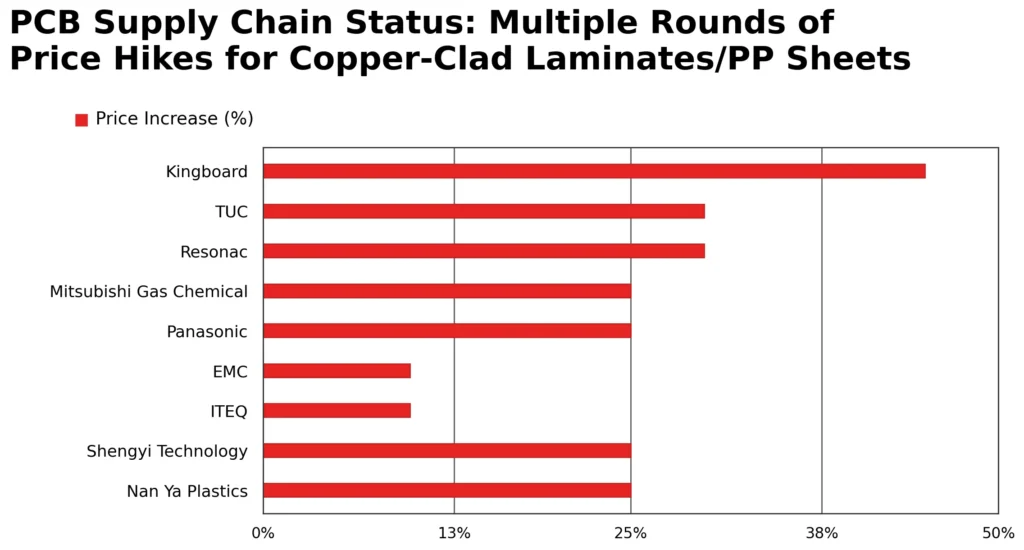
Compared with traditional FR-4 boards, these high-performance PCBs consume significantly more PP resin, increasing pressure on the existing resin supply chain.
At the same time, expanding PP resin production capacity is not a quick process. Building new chemical production lines requires significant investment, long construction periods, and extensive material qualification before mass production.
With demand rising faster than new capacity, the supply-demand gap is pushing up PP resin prices in 2026.
This rise in resin costs is also pushing up laminate costs. It adds more pressure to overall PCB manufacturing prices.
Rising Copper Prices Drive Up PCB Manufacturing Costs
In 2026, copper demand is rising sharply, and this is adding direct cost pressure to PCB manufacturing.
Copper is one of the most important raw materials in PCB production. It is used in circuit traces, power planes, ground planes, and copper foil. For AI server PCBs, and heavy copper PCBs, copper makes up an even larger share of the total cost.
Other parts of AI infrastructure are also becoming major sources of copper demand. Data centers need power systems, cooling facilities, and high-speed interconnect networks. These systems consume large amounts of copper.
At the same time, electric vehicles, power grid upgrades, and other industrial sectors continue to increase copper consumption.
Market data from Trading Economics also shows that copper prices were still significantly higher year over year in 2026. On July 8, 2026, copper was around 6.14 USD/lb, still about 12.73% higher than one year earlier. Trading Economics also projected copper to remain at a high level over the following months, reflecting continued tightness in the copper market.
For PCB manufacturers, this means copper price increases are not just a financial market issue. They directly affect copper foil prices, copper clad laminate costs, plating costs, and the total cost of high-performance PCB production. When copper demand grows faster than supply can expand, PCB factories have limited room to absorb the increase.
Geopolitical Risks Increase PCB Manufacturing Costs
Take the Strait of Hormuz as an example. When geopolitical risk rises in this region, the first impact is usually seen in oil, LNG, petrochemical products, and international shipping costs.
This pressure can quickly move into the PCB supply chain because PCB manufacturing is highly globalized. A factory may operate in China, but its specialty resins may come from Europe or the United States.
According to the International Energy Agency’s June 2026 Oil Market Report, Gulf supply losses and the need to restore disrupted shipping lanes added pressure to global oil supply. As oil and gas prices rise, the cost of petrochemical raw materials, resin systems, solvents, packaging materials, factory energy use, and logistics can also increase.
For PCB manufacturers, geopolitical risk does not always stop production directly. More often, it raises costs step by step through energy prices, chemical materials, and longer supply chain lead times.
PCB Purchasing logic is being redefined
In 2026, PCB procurement is returning to several practical questions:
Can buyers secure stable material supply?
How long can a quotation remain valid?
Can the supplier keep its delivery commitment?
Does the supplier have verified alternative material options?
Alternative materials are becoming a backup option for more companies. However, substitution does not mean simply changing brands.
Changes in Dk, Df, Tg, copper foil type, and material thickness can affect impedance control. They can also affect signal integrity and production yield. You should fully verify any alternative material before switching.
Contact HXD Circuit to discuss your next PCB project
Send your Gerber files and project requirements to us. Our engineering team will help you evaluate the best material choice, control unnecessary cost, and prepare a stable manufacturing plan for prototype or volume production.
Get StartedConclusion
AI servers, data centers, and fast communication networks use a lot of high-performance PCB materials. They also need advanced production capacity.
At the same time, raw material supply limits, energy cost changes, and international logistics risks are pushing up total supply chain costs from several directions.
For purchasing teams, the key question can no longer stop at, “How much does this PCB cost?” Buyers now need to evaluate material supply stability. They also need to check whether the supplier has enough engineering capability and supply chain management strength.