Blank PCB Guide: Types, Parts, and Key Specifications
 steve ran
July 1, 2026
steve ran
July 1, 2026
Think Deeper with AI:


What Is a Blank PCB?
A blank PCB is an unassembled printed circuit board. It has the board structure ready, but it does not have electronic components soldered on it yet.
In PCB manufacturing, a blank PCB often means a bare fabricated PCB. It may already include copper traces, drilled holes, plated vias, solder mask, silkscreen, and surface finish. It is called “blank” because it is still waiting for components such as resistors, ICs, capacitors, connectors, and LEDs.
A typical blank PCB may include these parts:
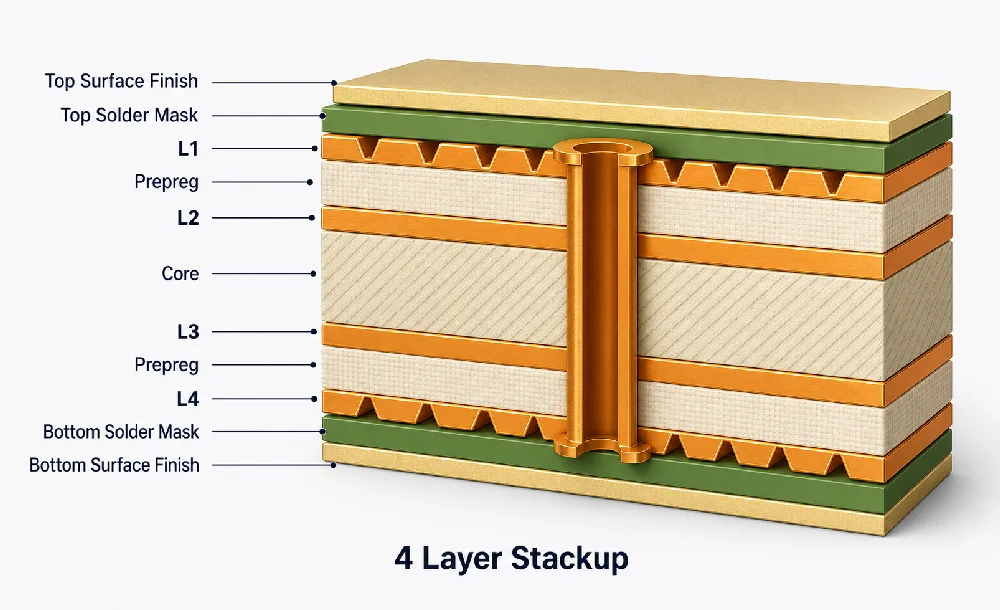
| Base Material | Gives the board strength and insulation. FR-4 is the most common material. |
| Copper Layer | Forms traces, pads, and planes that carry electrical signals and current. |
| Plated Vias | Connect copper layers in double-sided or multilayer PCBs. |
| Solder Mask | Protects copper and helps prevent solder bridges during assembly. |
| Surface Finish | Protects exposed copper pads and improves solderability. |
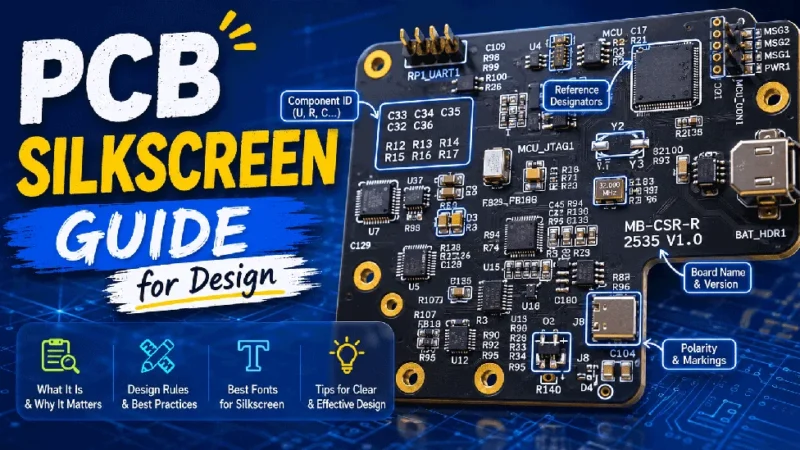
| Silkscreen | Shows labels, part numbers, polarity marks, and assembly information. |
Main Types of Blank PCB Boards
There are several types of blank PCB boards. Each one fits a different stage of product development.
Copper-Clad Blank PCB
A copper-clad blank PCB is a raw board with copper foil on the surface. It usually uses FR-4, paper phenolic, or another insulating base.
This board is common in DIY projects. Users draw or print a circuit pattern, then remove unwanted copper through etching or milling.
Copper-clad boards are useful for learning and quick lab work. But they have limits. They do not offer the same precision, plating, solder mask, or repeatability as professional PCB fabrication.
Prototype Blank PCB or Perfboard
A prototype board has holes or copper pads already placed in a grid. Engineers use it to solder wires, resistors, connectors, and small ICs by hand.
It is useful when speed matters more than layout quality. But it is not a good choice for high-speed signals, tight spaces, repeat production, or final product testing.
Custom Bare PCB
A custom bare PCB is made from design files. It can include copper traces, plated holes, vias, solder mask, silkscreen, surface finish, and panelization.
This is the best option when you need a real board for assembly, testing, or production.
For most engineers and buyers, this is the right meaning of blank PCB.
Single-Sided Blank PCB
A single-sided blank PCB has copper on one side. It is low cost and simple to make.
It works for simple circuits, LED boards, basic controls, and low-density layouts. But it has limited routing space.
Double-Sided Blank PCB
A double-sided blank PCB has copper on both sides. It supports more routing, vias, and better layout density.
It is common for prototypes, control boards, power boards, and many general electronics products.
Multilayer Bare PCB
A multilayer bare PCB has three or more conductive layers. Common options include 4-layer, 6-layer, 8-layer, and higher layer counts.
Multilayer boards help with power planes, ground planes, impedance control, EMI control, and compact layouts.
They are often used in industrial electronics, communication devices, automotive systems, medical products, and high-speed designs.
Need custom blank PCBs?
Contact HXD Circuit for fast file review and reliable PCB manufacturing.
Get StartedBlank PCB Parts
A blank PCB is only the board. It needs components mounted on the board before it becomes a functional circuit.
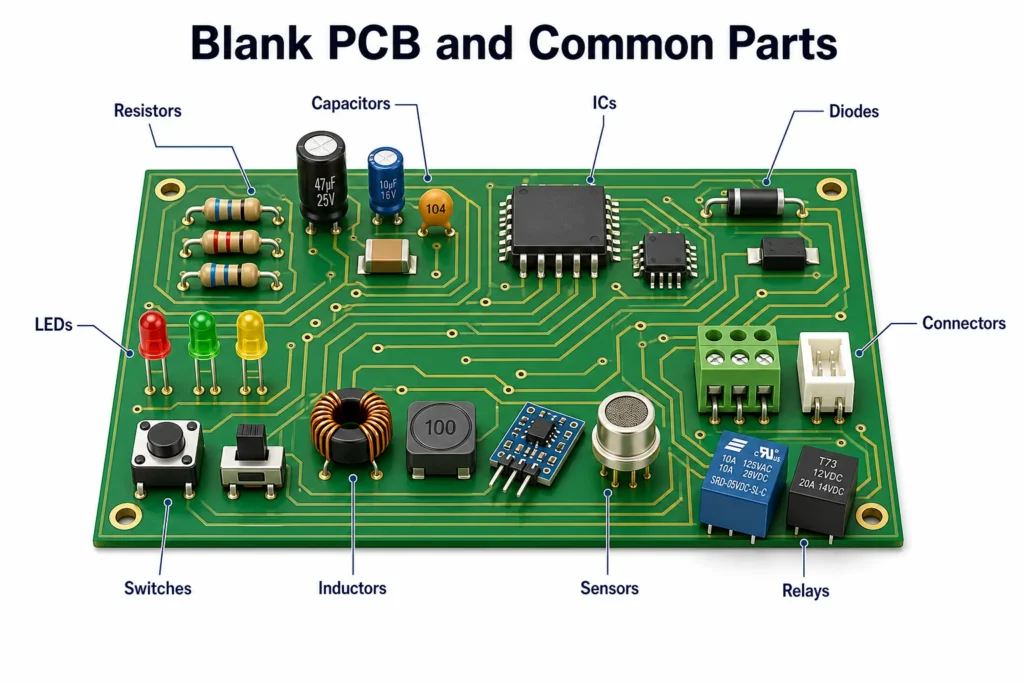
Common parts used on a blank PCB include:
| Resistors | Control current and divide voltage in the circuit. |
| Capacitors | Store energy, filter noise, and stabilize power. |
| ICs | Handle logic, control, signal processing, or power management. |
| Diodes | Control current direction and protect the circuit. |
| LEDs | Show power, status, warning, or signal output. |
| Connectors | Link the PCB to cables, modules, batteries, or other boards. |
| Switches | Let users control power, mode, or signal paths. |
| Inductors | Store energy in magnetic fields and support power circuits. |
| Sensors | Detect temperature, light, motion, pressure, or other signals. |
| Relays | Use a low-power signal to control a higher-power circuit. |
For example, a blank PCB may already have copper traces, pads, vias, solder mask, silkscreen, and surface finish. But it still needs parts such as resistors, capacitors, ICs, connectors, and sensors before it can operate.
You should confirm the service scope before ordering. If you need only the board, ask for blank PCB or bare PCB fabrication. If you need the board plus parts mounted, ask for PCB assembly or PCBA service.
Key Specifications of Blank PCBs
A blank PCB order is not only about size and quantity. The details control cost, lead time, and reliability.
Material
FR-4 is the most common PCB material. It works for many consumer, industrial, and control products.
Other materials include aluminum, Rogers, polyimide, and high-Tg FR-4.
Choose material based on heat, signal speed, flexibility, and working environment.
Layer Count
Layer count affects routing space, cost, EMI control, and board size.
Simple boards may use 1 or 2 layers. More complex designs may need 4, 6, 8, or more layers.
Board Thickness
Common board thickness is 1.6 mm, but many other values are possible.
Board thickness affects strength, connector fit, impedance, and mechanical assembly.
Copper Weight
Copper weight affects current capacity, heat spread, trace width, and etching quality.
1 oz copper is common for signal boards. Power boards may need 2 oz or heavier copper.
Surface Finish
Surface finish protects exposed copper and helps soldering.
Common options include HASL, lead-free HASL, ENIG, OSP, immersion silver, and immersion tin.
ENIG is often used for fine-pitch parts, flat pads, and better shelf life.
Solder Mask
Solder mask protects copper and reduces solder bridges.
Green is common, but other colors are possible. Color may affect cost or lead time depending on the factory.
Silkscreen
Silkscreen adds labels, part marks, polarity signs, logos, and assembly notes.
It helps engineers, technicians, and assembly teams avoid mistakes.
Hole Size and Tolerance
Drilled holes must match component leads, vias, screws, and connectors.
Small holes, tight tolerances, and many drill hits can raise cost.
Electrical Testing
Electrical testing checks for shorts and open circuits before assembly.
It is strongly recommended for custom bare PCB manufacturing.
Panelization
Panelization combines many boards into one production panel.
It helps assembly, improves handling, and can lower production cost.
Conclusion
If you need a real product board, request a custom bare PCB. Provide Gerber files, drill files, material type, copper weight, surface finish, and testing needs.
HXD Circuit can support blank PCB manufacturing from prototype to batch production, with practical review for materials, stack-up, and test needs.
FAQ
Frequently Asked Questions
Is electrical testing needed for blank PCB manufacturing?
Why does copper weight matter for blank PCB boards?
What material is best for a blank PCB board?
Aluminum works better for heat-heavy products, while Rogers or high-frequency materials fit RF, antenna, and fast signal designs.