IPC Class 2 vs. Class 3: What’s the Difference?
 steve ran
September 1, 2026
steve ran
September 1, 2026
Think Deeper with AI:


Introduction
IPC Class 2 and Class 3 serve different reliability needs.
Class 2 is for products that need reliable performance and a long service life. Some downtime or repairs are acceptable.
Class 3 covers critical products that must run all the time or on demand. Downtime or failure is not acceptable. Examples include life-support systems.
What Do IPC Class 2 and Class 3 Mean?
IPC defines three product classes based on performance and reliability needs. These classes are not separate standards.
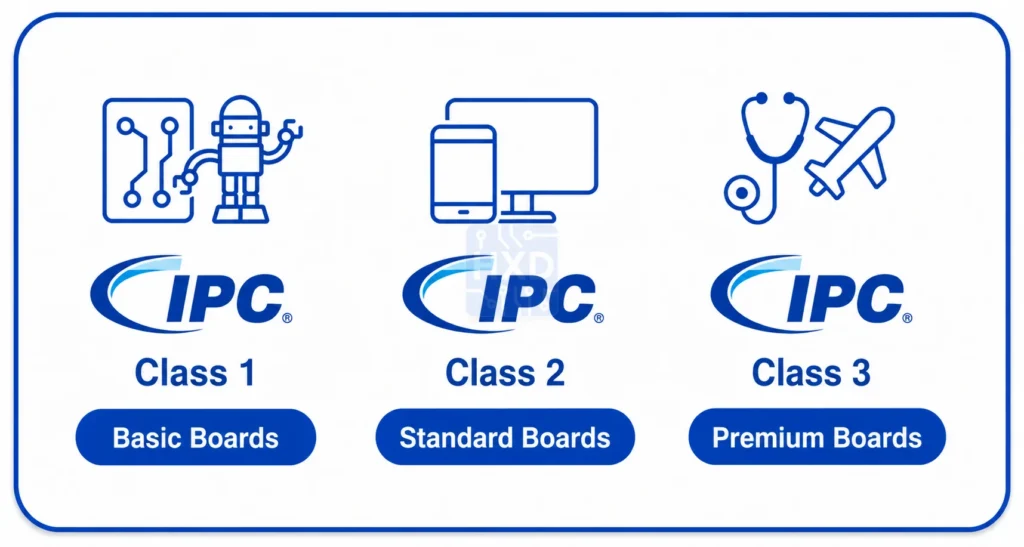
IPC-6011 provides the general performance framework. Product-specific standards apply it to different PCB types, such as IPC-6012 for rigid PCBs and IPC-6013 for flexible and rigid-flex PCBs.
The customer should specify the required class and any exceptions in the contract or purchase order.
What Does IPC-6012 Do?
IPC-6012 defines the performance requirements for rigid printed boards. It applies to several rigid-board constructions, including:
- Single-sided and double-sided boards
- Multilayer boards
- Boards with plated-through holes
- Boards with blind, buried, or microvias
- Metal-core boards
- Boards with embedded passive or active circuitry
IPC-6012 addresses materials, visual conditions, dimensions, conductors, structural integrity, electrical performance, cleanliness, solder mask, special requirements, acceptance testing, and quality assurance.
Most IPC-6012 requirements apply to the finished PCB. The standard defines performance and acceptance requirements rather than detailed PCB design rules.
IPC-6012F uses the three Performance Classes defined in IPC-6011. The customer selects the class based on product requirements and end use. Any exceptions require agreement between the customer and supplier.
What Does IPC-A-600 Do?
IPC-A-600 provides visual acceptance criteria for printed boards. It uses photos and illustrations to show acceptable and unacceptable PCB conditions.
Inspectors can use IPC-A-600 to evaluate conditions related to:
- Annular rings
- Conductor width and spacing
- Laminate imperfections
- Solder mask registration
- Plated-through-hole integrity
- Copper plating
- Voids, cracks, and other internal conditions
IPC-A-600 provides a visual interpretation of requirements found in printed-board specifications. It does not replace IPC-6012. A manufacturer still needs the applicable performance specification, procurement documents, and customer requirements.
PC-6012 vs. IPC-A-600
| Question | IPC-6012 | IPC-A-600 |
| Core purpose | Defines qualification and performance requirements for rigid printed boards | Illustrates acceptable and nonconforming printed-board conditions |
| Main users | Manufacturers, engineers, quality teams, and customers | Inspectors, quality teams, manufacturers, and buyers |
| Defines performance requirements | Yes | Not its primary role |
| Uses photographs and illustrations | Not its main purpose | Yes |
| Covers finished rigid boards | Yes | Covers observable conditions for several printed-board types |
| Can replace the other document | No | No |
IPC recommends using IPC-6012 and IPC-A-600 together. IPC-6012 defines the applicable requirements, while IPC-A-600 supports inspection and interpretation.
PCBA Standards: From Assembly Process to Acceptance
Bare-board standards do not define every requirement for a completed electronic assembly. Assembly manufacturers normally use J-STD-001 and IPC-A-610 for soldering, process control, workmanship, and post-assembly acceptance.
What Does J-STD-001 Do?
J-STD-001 describes the materials, methods, process requirements, and acceptance criteria used to produce soldered electrical and electronic assemblies. The standard relies on process control to achieve consistent manufacturing quality.
J-STD-001J also requires the user and manufacturer to agree on the product class. The user should identify the class. If the user does not document one, the manufacturer may select it.
The standard connects assembly requirements with the relevant board documents.
For rigid PCBs, it references IPC-2222 for design, IPC-6012 for fabrication, and IPC-A-600 for acceptance.
What Does IPC-A-610 Do?
IPC-A-610 defines visual acceptance requirements for completed electronic assemblies, including component installation, solder joints, surface-mount and through-hole connections, and workmanship.
It focuses on post-assembly acceptance rather than manufacturing processes. J-STD-001 covers soldering materials and process requirements, so manufacturers commonly use the two standards together.
Does Class 3 Require More Testing and Inspection?
Class 3 may need stricter acceptance limits than Class 2. It may also need more checks. However, it does not always need every inspection or test method.
IPC-6012F covers visual inspection, microsectioning, electrical requirements, acceptance testing, sampling, and other quality controls. The actual requirements depend on the PCB construction, selected class, and procurement documents.
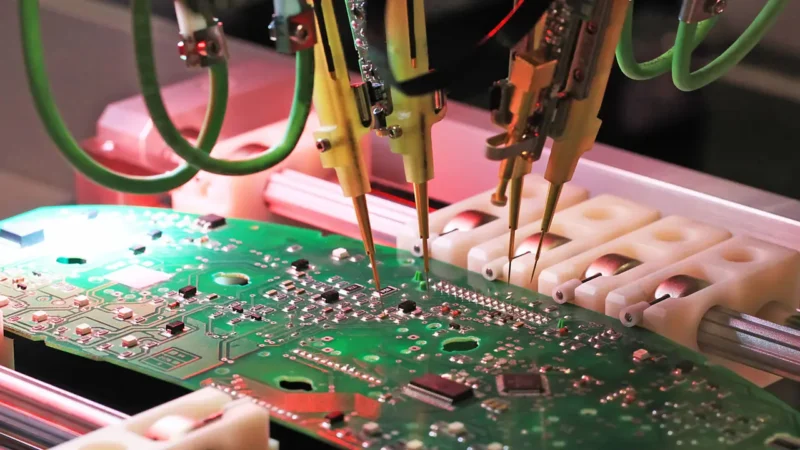
Different methods verify different conditions. Visual inspection and AOI check visible features, microsectioning examines internal structures, X-ray reveals hidden features, and electrical or functional testing verifies electrical performance.
You should clearly specify any required test reports, microsection reports, or certificates. A Class 3 callout alone does not define every inspection or documentation requirement.
Does Class 3 Cost More Than Class 2?
Class 3 PCBs usually cost more because they may require tighter process control, additional inspection, and more documentation. The cost difference can be greater for HDI, multilayer, and small-hole designs.
The actual cost depends on PCB complexity, quantity, materials, testing, and supplier capability.
Can a Class 2 Bare PCB Be Used for a Class 3 PCBA?
A Class 2 bare PCB cannot be used when the finished assembly requires full Class 3 status. The final assembly class cannot exceed the bare-board class, so a Class 3 PCBA requires a Class 3 PCB.
Class 3 assembly inspection cannot upgrade a Class 2 PCB to Class 3.
You should specify the applicable requirements separately for the bare PCB and the completed assembly.
Can a Class 2 PCB Still Meet Some Class 3 Criteria?
Yes. A Class 2 PCB may meet some individual Class 3 criteria, such as annular ring or plating requirements.
However, meeting a few Class 3 criteria does not make the entire PCB Class 3. The Class 3 requirements must be clearly specified and fully met.
How Do Class 2 and Class 3 Acceptance Requirements Differ?
Class 3 generally has stricter acceptance criteria than Class 2, but not every requirement is different.
The exact limits depend on the PCB feature, such as supported holes, internal lands, or microvias. Always check the applicable IPC standard and revision for the specific requirement.
Annular Ring and Drill Breakout
An annular ring is the copper around a finished hole. Drill breakout occurs when the hole extends beyond the land because of drilling or registration variation.
Class 2 may allow limited internal breakout, while Class 3 generally requires a complete internal annular ring.
However, the exact acceptance criteria depend on the hole type, PCB structure, and applicable IPC revision.
No single Class 3 annular-ring value applies to every PCB design.
Plated-Through-Hole Integrity
A plated-through hole uses copper plating on the hole wall to connect different PCB layers.
IPC-6012F covers conditions such as plating thickness, voids, cracks, copper wrap, and filled vias. Some Class 3 requirements are stricter than Class 2, but the exact criteria depend on the hole type and PCB construction.
Therefore, there is no single copper-thickness requirement that applies to every PTH, blind via, buried via, or microvia.
Conductor and Laminate Conditions
Class 2 and Class 3 may have different requirements for conductors, internal connections, laminate defects, dielectric spacing, and copper thickness.
However, Class 3 does not automatically require tighter dimensions or tolerances for every PCB feature. Design requirements also depend on the IPC-2220 series, electrical and safety needs.
Assembly Acceptance
Class 2 and Class 3 may have different acceptance criteria for component installation, solder joints, terminals, and workmanship.
J-STD-001 defines soldering materials and process requirements, while IPC-A-610 provides visual acceptance criteria for completed assemblies.
Evaluate bare PCB and PCBA requirements separately. The exact Class 2 or Class 3 criteria depend on the applicable standard, revision, connection type, and procurement requirements.
How to Choose Between Class 2 and Class 3
Choose the class according to the product’s required service level and the consequences of failure. Do not select Class 3 only because it sounds more reliable.
J-STD-001J assigns the user responsibility for identifying the assembly class. IPC-6011 assigns a similar responsibility for printed boards. Both documents connect classification to the intended end use.
Need a Class 2 or Class 3 PCB?
Not sure which IPC class your project requires? Send us your PCB files and requirements. Our engineering team can review your project and help you choose the right manufacturing and inspection requirements.
Get StartedCommon Specification Mistakes
Writing Only “IPC Class 3 Required”
A class callout alone may not clearly show whether it applies to the bare PCB, PCBA, or both. Specify the controlling documents, revisions, class, and any required addenda.
Treating Class as an IPC Certification
IPC offers certifications and endorsements for people and organizations. A product’s Performance Class remains a separate matter. A trained inspector or certified specialist does not automatically make every product Class 3.
Using IPC-A-600 for a PCBA
IPC-A-600 provides inspection criteria for printed boards. IPC-A-610 addresses electronic assemblies.
Using IPC-A-610 for a Bare Board
IPC-A-610 evaluates assembled products. Use the applicable IPC-6010-series performance specification and IPC-A-600 for bare-board requirements.
Treating IPC-6012 as a Complete Design Standard
IPC-6012 defines performance requirements for rigid PCBs. The IPC-2220 series addresses PCB design. J-STD-001J lists IPC-2222 under rigid-board design and IPC-6012 with IPC-A-600 under fabrication.
Changing the Class After Layout
A late change may require another review of manufacturing margins, board construction, acceptance criteria, test requirements, and supplier capability. Changing a drawing note alone does not prove compliance.
Assuming Class 3 Requires High-Tg Material
Performance Class does not automatically select one laminate system. IPC-6012F treats laminate material selection and Performance Classification as separate procurement topics. Material choice should follow the thermal, electrical, mechanical, regulatory, and assembly requirements.
Assuming Class 3 Includes Every Test and Report
The class does not define every customer deliverable. Specify required reports, certificates, traceability, tests, and retained samples in the procurement package.
Using Requirements from an Outdated Revision
IPC revises standards over time. At the time of writing, IPC lists IPC-6011A, IPC-6012F, IPC-A-600M, J-STD-001J, and IPC-A-610J as current revisions. Contracts may still invoke an earlier revision, so every purchase order should state the required revision.
Assuming Class 3 Guarantees Zero Failures
Class 3 defines performance and acceptance requirements. It cannot correct circuit-design errors, unsuitable components, software defects, improper environmental assumptions, or missing product-level validation.
Conclusion
IPC Class 2 and Class 3 are Performance Classes, not separate standards.
Class 2 covers products that need reliable performance and a long service life. Class 3 covers critical products where failure or downtime is not acceptable.
IPC-6012 and IPC-A-600 cover bare PCB requirements and inspection, while J-STD-001 and IPC-A-610 apply to soldered assemblies.
Choose the required class early and clearly specify the applicable standards, revisions, testing, and documentation requirements.
FAQ